3D Moment of Inertia Tensor & Poinsot's Ellipsoid Visualizer - Principal Axes, Kinetic Energy, and Non-Collinear Angular Momentum
Interactive Physics Ready
Click "Run Code" to launch simulation and interactive parameter sliders.
Mathematical Problem Formulation
Theoretical Background & Explanation
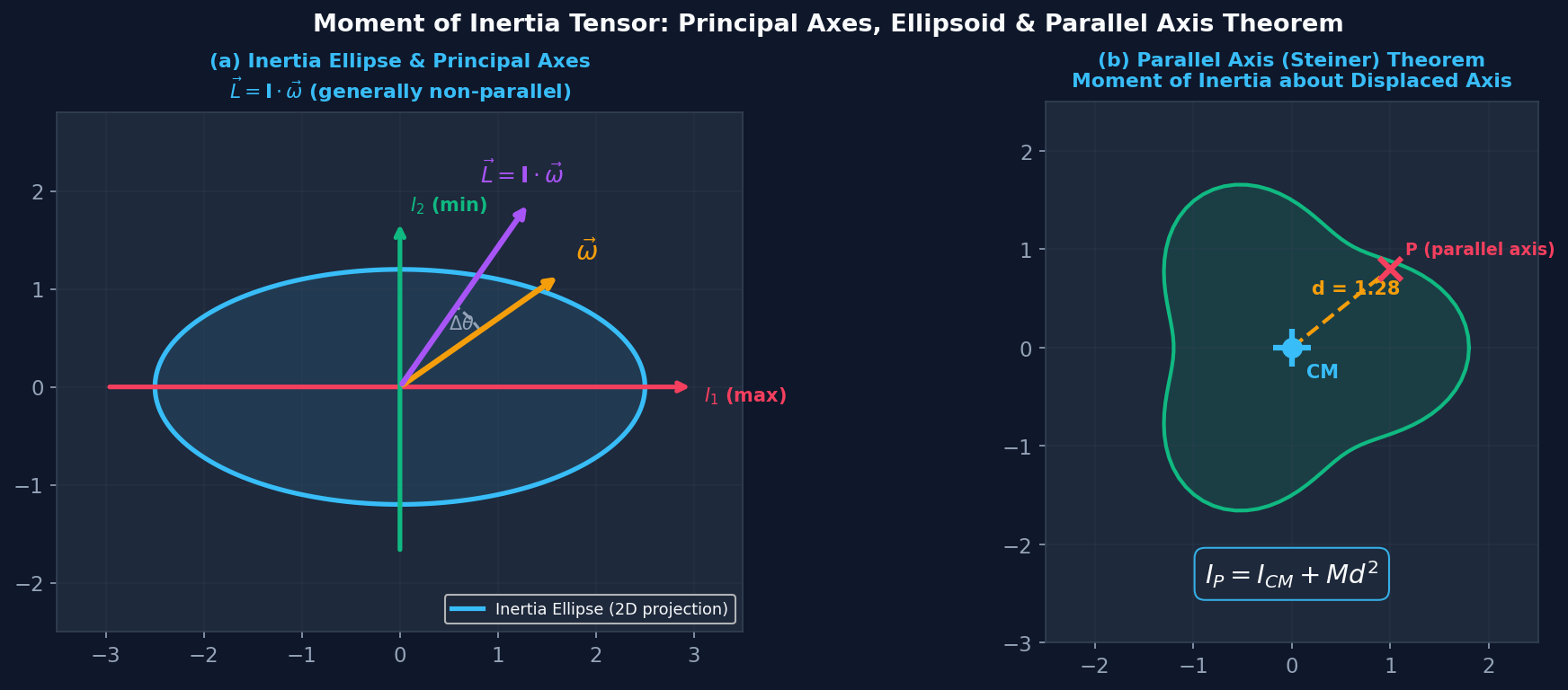
Figure 2.3: Moment of Inertia Tensor & Poinsot's Ellipsoid: (a) Poinsot's kinetic energy ellipsoid $2T = \vec{\omega}^T [I] \vec{\omega}$ showing non-collinearity between $\vec{\omega}$ and $\vec{L} = [I]\vec{\omega}$, (b) Principal axes of an asymmetric rigid body.
Rotational Dynamics & The Inertia Tensor
In linear mechanics, mass is a simple scalar constant ($p = mv$). In 3D rotational mechanics, however, an applied torque does not generally produce an angular acceleration in the same direction! The relationship between angular velocity $\vec{\omega}$ and angular momentum $\vec{L}$ is governed by the moment of inertia tensor $[I]$: $$\vec{L} = [I]\vec{\omega}$$
1. Definition of the Inertia Tensor
For a continuous mass distribution $\rho(\vec{r})$, the components of the symmetric rank-2 inertia tensor are defined by:
The diagonal entries $I_{xx}, I_{yy}, I_{zz}$ are the moments of inertia about the coordinate axes, while the off-diagonal entries $I_{xy}, I_{yz}, I_{zx}$ are the products of inertia.
2. Principal Axes of Inertia & Diagonalization
Because $[I]$ is a real symmetric tensor, the spectral theorem guarantees the existence of an orthonormal basis of eigenvectors (the principal axes) in which $[I]$ is strictly diagonal:
Only when rotation occurs along one of these three principal axes are $\vec{L}$ and $\vec{\omega}$ collinear ($\vec{L} = I_k \vec{\omega}$). For any arbitrary rotation axis, $\vec{L}$ tilts away from $\vec{\omega}$!
3. Rotational Kinetic Energy & Poinsot's Ellipsoid
The rotational kinetic energy is a quadratic form in $\vec{\omega}$:
Louis Poinsot (1834) introduced the geometric visualization known as Poinsot's Ellipsoid: $$I_1 x^2 + I_2 y^2 + I_3 z^2 = 2 T_{\text{rot}}$$ In torque-free rotation, both $T_{\text{rot}}$ and $|\vec{L}|$ are strictly conserved. The angular momentum vector $\vec{L}$ is orthogonal to the tangent plane of this ellipsoid at the tip of $\vec{\omega}$, causing the ellipsoid to roll without slipping on an invariant plane!
Physics Problem - Rotational Stability of Asymmetric Rigid Body & Dzhanibekov / Tennis Racket Effect via Euler's Equations
Interactive Physics Ready
Click "Run Code" to launch simulation and interactive parameter sliders.
Mathematical Problem Formulation
Theoretical Background & Explanation
The Dzhanibekov Effect / Tennis Racket Theorem
In 1985, Soviet cosmonaut Vladimir Dzhanibekov observed aboard the Salyut 7 space station that a wing nut spinning in microgravity about its intermediate principal axis flips its orientation by $180^\circ$ at regular intervals. This counter-intuitive behavior—also known as the Tennis Racket Theorem—is a rigorous mathematical consequence of Euler's equations of motion for an asymmetric rigid body ($I_1 < I_2 < I_3$).
1. Euler's Equations for Torque-Free Rotation
In the body-fixed principal frame of reference, torque-free rotational dynamics ($\vec{\tau} = 0$) are governed by Euler's non-linear differential equations:
Where $I_1 < I_2 < I_3$ are the ordered principal moments of inertia.
2. Perturbation Analysis: Proof of Stability & Instability
Let us test the stability of steady rotation $\Omega$ about each principal axis under small perturbations $\eta_i \ll \Omega$:
Case 1: Rotation about Axis 1 (Minimum Moment $I_1$):
$$\vec{\omega} = (\Omega, \eta_2, \eta_3) \implies \ddot{\eta}_2 = -\Omega^2 \frac{(I_1 - I_3)(I_1 - I_2)}{I_2 I_3}\eta_2$$ Since $I_1 < I_2 < I_3$, both $(I_1 - I_3) < 0$ and $(I_1 - I_2) < 0$, their product is positive: $$\ddot{\eta}_2 + \omega_0^2 \eta_2 = 0 \implies \text{Bounded Harmonic Oscillation } \implies \mathbf{STABLE!}$$Case 2: Rotation about Axis 2 (Intermediate Moment $I_2$):
$$\vec{\omega} = (\eta_1, \Omega, \eta_3) \implies \ddot{\eta}_1 = \Omega^2 \frac{(I_2 - I_3)(I_2 - I_1)}{I_1 I_3}\eta_1$$ Here, $(I_2 - I_3) < 0$ but $(I_2 - I_1) > 0$, so their product is strictly negative: $$\ddot{\eta}_1 - \lambda^2 \eta_1 = 0 \implies \eta_1(t) \sim e^{+\lambda t} \implies \mathbf{EXPONENTIAL\ INSTABILITY!}$$Case 3: Rotation about Axis 3 (Maximum Moment $I_3$):
Both $(I_3 - I_1) > 0$ and $(I_3 - I_2) > 0$, product is positive $\implies \mathbf{STABLE!}$3. Geometric Interpretation on Poinsot's Ellipsoid
In phase space, the trajectory of $\vec{\omega}$ is the curve of intersection between the energy ellipsoid ($2E = \vec{\omega}^T [I] \vec{\omega}$) and the angular momentum sphere ($L^2 = \vec{\omega}^T [I]^2 \vec{\omega}$). Around axes 1 and 3, the intersections form closed concentric topological circles (elliptic fixed points). Around intermediate axis 2, however, the intersection forms a figure-eight separatrix with a hyperbolic saddle point, forcing any perturbed state to make complete $180^\circ$ excursions between $+\Omega$ and $-\Omega$!